Location
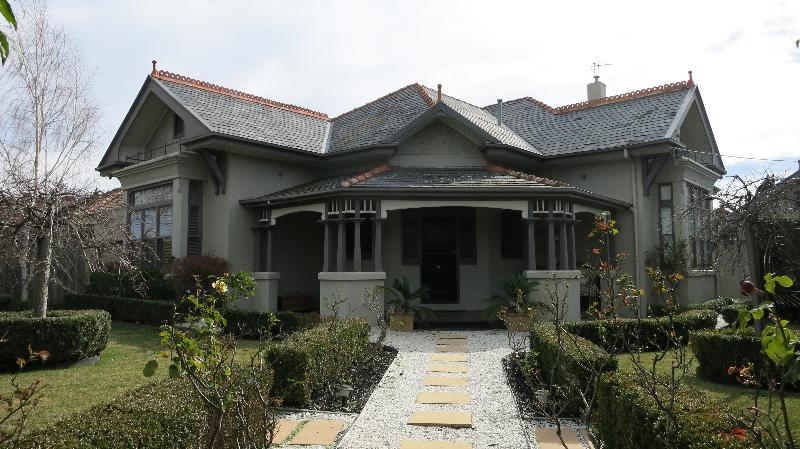
1121 Dandenong Road MALVERN EAST
Construction Type
Monolithic concrete
History
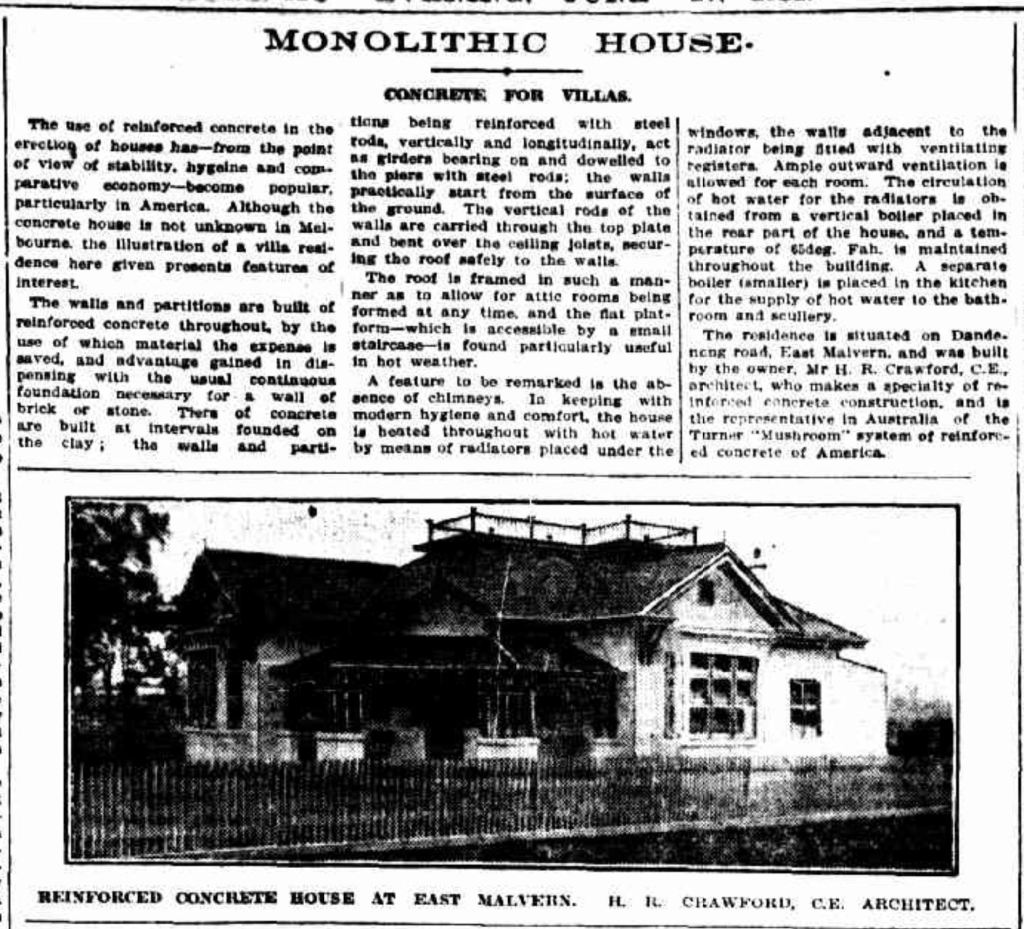
Hugh Ralston Crawford was granted an Australian patent in 1907 for a monolithic reinforced concrete cavity wall,159 and built a number of Melbourne houses on this system. Crawford was born in the United States in 1876, but came with his parents to Queensland as a child. He was articled to the Townsville civil engineers and architects Eyre & Munro, and then in 1896 joined the Queensland Government’s Bridge Department as a designing engineer, and later became engineer in charge of railway construction. He also appears to have been in India for a time. From 1906 to 1914 Crawford conducted a private practice in Melbourne specialising in steel and reinforced concrete building. From 1914 to 1919 he was employed by the Metcalf Co. of Montreal in constructing wheat silos for the New South Wales Government. In 1919 he was appointed Consulting Engineer for concrete to the Commonwealth Government. In his Melbourne practice he did much of his work at night, and was an innovative designer who was responsible for silos and other structures as well as those on the Turner system.
Illustrations survive of two Melbourne houses by Crawford, not otherwise documented or dated. The most problematic is the Paton house at 89 Broadway, East Camberwell, for it has an absolutely conventional Edwardian appearance and appears to have at least an exterior facing of brick. The other, in Mont Albert Road, Canterbury, is again very conventionally Edwardian but is visibly of concrete, and is stated to have hollow external walls in accordance with Crawford’s patent.161 His own house, built in about 1912 at 1121 Dandenong Road, East Malvern, survives and is slightly more interesting in appearance.162 Another house by Crawford at 150 Winmalee Road, Balwyn, has been reported to me by the owners.
Miles Lewis: 7.05 Cement & Concrete: Reinforced Concrete: 04
‘Charter Oak’ is a fine and representative example of a Federation house. It displays typical features of the Federation Bungalow architectural style popular in the 1910s in Malvern East and across Melbourne more broadly, including simple massing with wide-spreading roof form and attic rooms, a deep verandah and sturdy timber verandah posts with masonry piers. It also displays some characteristics more typical of the Federation Arts and Crafts architectural style, such as the symmetrical, butterfly plan form (Criterion D).
‘Charter Oak’ is a well-considered and carefully detailed example of what can broadly be defined as a Federation Bungalow house. The simple symmetrical design, with main hipped roof and prominent gabled bays, together with the restrained use of distinctive architectural elements, presents a picturesque composition of this architectural style (Criterion E).
‘Charter Oak’ is an early and unusual example of reinforced concrete construction in Malvern East and the municipality more broadly. It demonstrates the architect H R Crawford’s innovative use of this material in residential work (Criterion F)
Map
Heritage Listings
https://vhd.heritagecouncil.vic.gov.au/places/201908
Current Use
Residence
 Concrete Houses of Australia